
The average ticket: the four levers almost nobody looks at
The customer is already in the shop, wallet in hand. Getting them to spend a little more costs a fraction of what it costs to bring in a new one — yet it remains the most neglected lever. Four concrete levers to work on it properly.
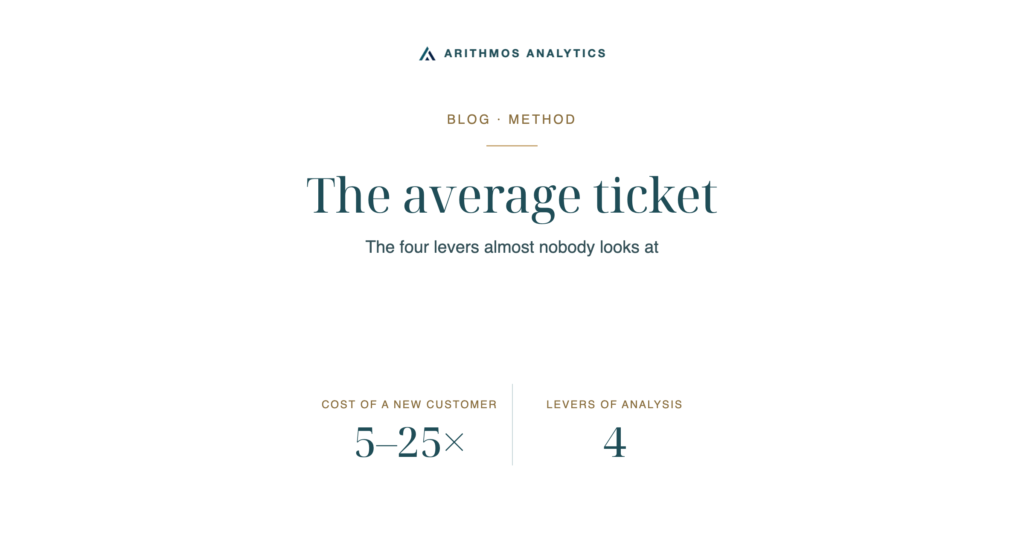
A customer is already in your shop, wallet in hand. Getting them to spend a little more costs you almost nothing — far less than it costs to bring in a new customer.
Why it costs less to make existing customers spend more
It is not only intuition. Studies by Frederick Reichheld (Bain & Company, taken up by Harvard Business Review) estimate that acquiring a new customer can cost between 5 and 25 times more than generating an additional sale from someone already in your shop. Yet most interventions on a point of sale bet everything on traffic: more advertising, more window display, more promotions to get people in. The average ticket — how much someone already inside spends — remains the most neglected lever, even though it is the one on which you have the most direct control.
The four levers
The average ticket can be analysed along four concrete levers.
- Purchase associations. Which products are bought together, and how to tell that apart from the simple “both sell well separately”. In statistics this is measured with lift: a value above 1 means two products are bought together more often than you would expect by pure chance — only then is the association real, not an illusion caused by both simply being popular.
- Path through the shop. Where the associated products are today, and how far apart they are. If two items are often bought together but sit at opposite ends of the shop, that distance is margin left on the shelf.
- Thresholds and bundles. Giving the customer a reason to add an item that they perceive as advantageous, not as sales pressure — a spending threshold, a natural pairing, a small incentive to complete the purchase instead of forcing it.
- The last metre. The checkout is the moment with the highest purchase propensity of the whole journey — the customer has already decided to buy, already has the wallet in hand — and it is the spot most often left empty, with nothing inviting one last small purchase.
An audit path, not a restyling
From this framework we built a six-step audit path, applicable to any retail point of sale, regardless of format or size of the range. It is not a visual merchandising intervention: it is an analysis that starts from the real data on what is bought together and arrives at a layout and a checkout counter designed for that data, not for habit.
If you want to go deeper into the full framework for your business, write to us.
Sources: Frederick Reichheld / Bain & Company, Harvard Business Review (“The Value of Keeping the Right Customers”, 2014); market basket analysis literature on support, confidence and lift.