
Seasonal staff: keep them or hope they come back?
You find a seasonal worker who turns out to be good. When the season ends, do you keep them knowing they will weigh on the payroll in the low months, or hope they come back next year? It is not a trivial question — it is a decision worth a precise figure, not a hunch.
You find someone who works with you for the season. They turn out to be right for the job. What do you do when the season ends? Do you decide to keep them even knowing they will be a weight on the payroll, or do you simply hope they come back next season?
The cost of letting them go
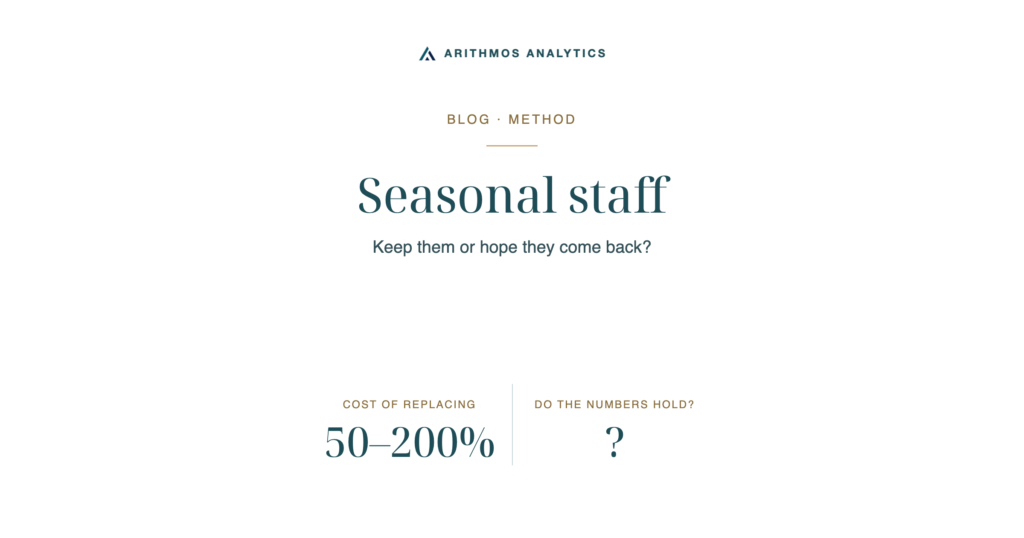
It seems the simplest choice: the season ends, the contract ends, we will see next year. But “we will see” has a cost that is rarely put in writing. According to the Society for Human Resource Management (SHRM), replacing a trained person costs on average between 50% and 200% of their annual salary, across selection, training and lost productivity in the first months. For a seasonal role the absolute numbers are smaller, but the proportion remains: someone you have already trained well is worth more than someone you will have to train from scratch, hoping they will be just as good.
The cost of keeping them
Keeping them, however, is not free either. Off season the work drops, and a fixed salary against shrinking revenue weighs on the income statement exactly when the margin is already tighter. The real question is not “is it worth keeping them or not” in the abstract — it is whether the business, in the low months, can really afford that weight, or whether it will only find out by looking at the bank statement at the end of the month.
A decision, not a hope
The problem with “let’s hope they come back” is that it is not a decision — it is a postponement. In the meantime the good person you found can accept an offer elsewhere, and at the start of the next season you find yourself training another one from zero, with the same risk as before.
The right choice depends on a precise number: how much margin you really have in the low months to absorb that cost. Those who know it, decide. Those who do not, hope.
A question for anyone running a seasonal small business: if you had to keep your best person even in the dead months, do you already know whether the numbers would work?
Source: Society for Human Resource Management (SHRM), estimates of the cost of replacing a trained employee.