
Three numbers every small business should check every month
You don't need an accountant to start looking at the right numbers. Three simple calculations, done regularly, are enough to see how the business is really doing — long before problems show up in the bank account.
Most people who run a bar, a shop or a studio have a “feeling” for how the month is going. Sales seem good, the tables are full, customers come back. But a feeling is not a number, and the surprise often arrives at the end of the year, when the accountant closes the books.
Here are three numbers you can calculate in ten minutes, every month, and that say far more than a feeling.
1. Operating margin
It is what is left of revenue after removing all the costs of running the business — not just the goods, but also rent, utilities, staff, everything. It is calculated like this:
(Revenue − Total costs) ÷ Revenue × 100
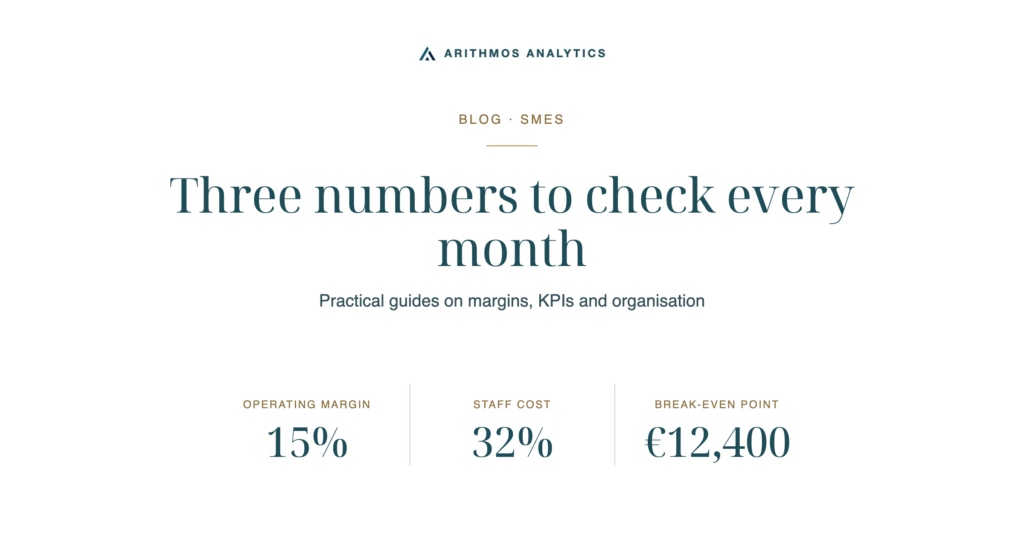
If a month brings in €20,000 and total costs are €17,000, the operating margin is 15%. There is no “right” threshold that is the same for every sector — a restaurant and a consulting practice have very different cost structures — but the point is another one: if you calculate it every month, you see straight away when something moves in the wrong direction, long before it becomes a serious problem.
2. Staff cost ratio
For anyone with employees or collaborators, it is often the largest cost after goods — and the easiest to underestimate, because between salaries, contributions and overtime the real total is always higher than it looks by eye.
Staff cost ÷ Revenue × 100
If this number grows month after month without revenue growing at the same pace, it is a signal to look at before it turns into a margin that quietly thins out.
3. Break-even point
It is the most practical question of all: how much do you need to take in this month before you really start to earn? It is calculated by dividing fixed costs (the ones you pay anyway, whether you sell or not: rent, basic utilities, fixed salaries) by the margin left on every euro sold after variable costs.
Knowing this number changes the way you read every week: no longer “did we sell a lot or a little”, but “are we already past break-even, or not yet”.
None of these three numbers requires complicated software. It only requires the discipline to calculate them regularly, and the ability to read them in the right context — a 15% margin can be excellent in one sector and alarming in another.
It is exactly where Arithmos’s analysis starts: taking these numbers, and others specific to your type of business, and returning a clear reading of what is really happening — not a dashboard you have to interpret on your own.