
Revenue: what it is, when it matters and when it does not
Revenue is what you have sold, not what you have earned nor what you have collected. When it matters less than it seems, and how it changes from one trade to another: revenue, margin and cash are three different questions.
Revenue is the total of what you have sold. It is not what you have earned and it is not what you have collected.
For accounting purposes, revenue arises when you deliver the product or perform the service, not when the customer pays: so state OIC 34 in Italy and IFRS 15 internationally.
When it matters less than it seems
- There is VAT. It is not yours: you collect it on behalf of the State.
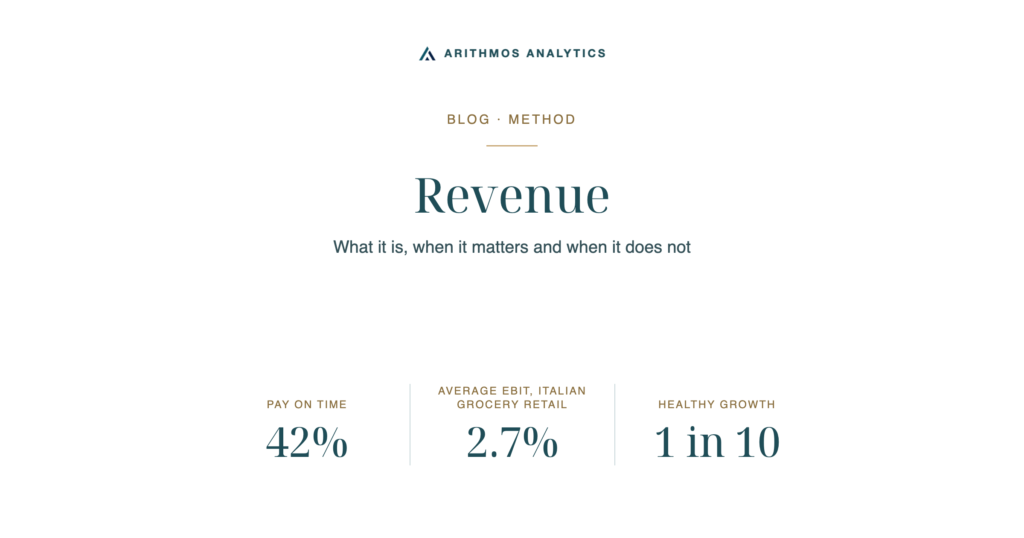
- The invoice is not paid. In the second quarter of 2026 only 42.0% of Italian companies paid on the due date, and among large companies only 21.1%.
- There are discounts and returns. What really comes in is what you sold minus what you refund or allow.
- You collect on behalf of others. Often your revenue is only the commission, not the total that passes through your hands.
Three different questions
Revenue, margin and cash are not three ways of saying the same thing. They are three questions: how much have I sold, how much is left after costs, and when does money come in and go out.
Margin. Italian food retail had an EBIT of 2.7% in 2024: on €100,000 of sales, €2,700 is left. All else equal in sales and costs, a 3% discount on everything would cost €3,000 — more than the entire profit.
Cash (invented example). A consultant invoices €30,000 in March and the client pays at 90 days. In the meantime salaries and rent have to be paid with money they have not yet collected.
Every trade counts in its own way
- Hospitality. RevPAR (revenue per available room) is occupancy × average rate. Italy, second quarter 2026: 76.9% × €172.38 ≈ €132.6 (our calculation). Central Italy: 80.2% × €205.60 ≈ €164.9, about 24% more.
- Retail. It is measured per square metre. In 2024 Esselunga sold €16,071 per m² (net of VAT, on the domestic market), Tesco €12,893.
- Agriculture. In 2025 the value of production rose 3.9%, but volumes only 0.3%: almost all the growth comes from prices. And value added, that is what is left to the sector, stayed flat (−0.1%).
- Services. Hours × rate × hours actually invoiced. But payment comes later.
- Food service. Covers × average ticket. In 2024 the balance between openings and closures was −18,378 businesses (10,719 new, 29,097 ceased).
Growing in revenue is easy, growing well is rare
Chris Zook, of Bain & Company, looked for companies that for ten years grew both revenue and profit by at least 5.5% a year in real terms, also earning the cost of capital. Only about 1 in 10 (11%, according to Bain) managed it, and the common thread was a strong focus on the core business. The study mainly concerns large companies, but the lesson holds for everyone.
High revenue, low margin and slow collections is not a healthy company. It is a very busy company.
Sources
- OIC 34, Revenues (via Assolombarda); ICAEW, IFRS 15
- CRIBIS, Payments Study, second quarter 2026
- Mediobanca Research Department, Observatory on Italian food retail (2024 data)
- Trademark Italia, Italian Hotel Monitor, second quarter 2026
- ISTAT, Economic accounts for agriculture, year 2025
- FIPE, Restaurant Report 2025
- Chris Zook, Profit from the Core (2001), Bain & Company