
Agentic AI: what it can really do for a small business
A chatbot answers a question; an agent completes a goal. Adoption among small businesses is growing faster than in large companies — but the real difference is not whether to automate, it is how much autonomy to grant, and where.
For much of the last decade, “automation” for a small business meant a handful of tools disconnected from one another: an email autoresponder, a booking link, maybe a chatbot that answered three questions before handing over to a person. Each tool did one thing only, and someone still had to put the results together by hand.
Agentic artificial intelligence is a different category of tool, and the difference matters more than the marketing around it suggests. Agentic AI refers to systems that plan, decide and execute multi-step tasks autonomously, instead of just answering a single prompt. It is not a philosophical distinction. A chatbot answers a question. An agent receives a goal — reconcile this week’s takings, flag something unusual, prepare the reminder — and carries out the sequence of steps needed to get there, asking for confirmation only where it has been told to.
The adoption curve is real, and it is growing faster among small businesses than in large companies
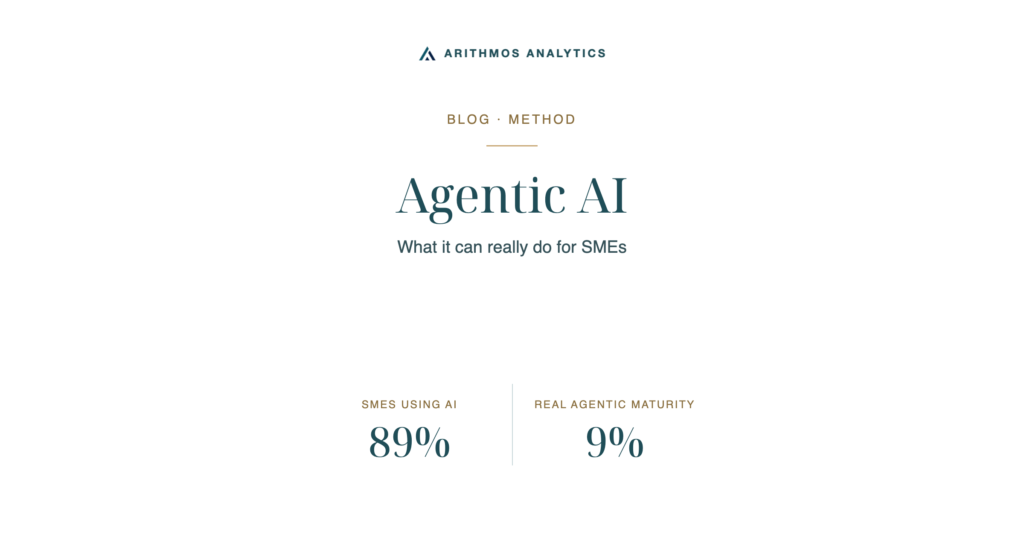
The 2026 numbers tell a clear story, even if not a uniform one. About 38% of small and medium-sized businesses already use AI assistants or process automation tools for specific functions such as customer service, marketing and recruitment. Broader surveys, which measure the use of any artificial intelligence tool and not just process automation, push the figure much higher: an Intuit and ICIC report found that 89% of small businesses now use artificial intelligence in some form, mainly for repetitive tasks. The two figures do not contradict each other, they measure different things, but the underlying point is the same: among small businesses, adoption is no longer the exception.
What matters more than the raw adoption number is who is adopting faster. Small and medium-sized businesses are often in a better position than large organisations to adopt agentic AI because they carry fewer legacy-system constraints — no ten-year-old ERP to migrate, no purchasing committee to go through. A five-person business can start using an agent this week. A 5,000-person company is often still working out which department owns the decision.
That said, it is worth being precise about what “adoption” really means. A recent review of Q3 2026 company data found that concrete maturity in autonomous workflows concerns only 9% of large enterprises, even though 59% say they use agentic AI in some form — a useful reminder that trying a tool once and really using it in production are not the same thing, not even for a small business.
What agentic workflows really do for a small business
Stripped of marketing terms, the practical use cases for a small business cluster around a handful of tasks that consume time without requiring a person’s full attention.
- Data collection and categorisation. A good part of a small business’s real financial situation lives in scattered formats: a till closing, a pile of supplier invoices, a handwritten note. An agent can read these inputs, categorise them consistently and — this is the critical point — flag what it cannot read instead of guessing. That last detail matters more than it seems: the goal is not a system that is always sure of itself, it is a system that is honest about what it does not know.
- Monitoring and early warning. Instead of a person checking five different sources every morning, an agent can keep an eye on what moves a small business’s numbers — weather, local events, a strike, a long weekend — and flag only what is relevant, with enough advance notice to really act on it (move a shift, correct an order) instead of finding out after the fact.
- Turning raw numbers into something readable. The calculation itself — margins, cost ratios, trend comparisons — does not need to be creative. It needs to be consistent: the same input must always produce the same result. This is where agentic systems built on deterministic calculation engines differ substantially from a generic chatbot asked to “do the sums”: a language model that estimates a percentage and a calculation engine that computes it are not interchangeable, and for financial reporting only one of the two is acceptable.
- Following the human side of the business. What is left pending, who is waiting for a reply, when to get back in touch — the kind of relationship management that is genuinely useful and genuinely boring, and that nobody ever really finds time for at eleven at night.
The data confirm where the benefits concentrate. Among companies actively building agents, customer service is the most common use case, at 26.5%, followed by research and data analysis at 24.4%, and internal process automation at 18%. It is no accident: these are the three areas where a small business owner has the least free time and the most repetitive load.
Why “agentic” does not mean “uncontrolled”
The most useful distinction in this entire field is not adoption versus non-adoption. It is how much autonomy a company really wants to grant, and where. The sector has largely settled on two models. In a human-in-the-loop setup, the agent stops at a defined checkpoint and requires explicit approval before proceeding: appropriate when the risk of error is high or the action is hard to undo. In a more autonomous setup, the agent completes the whole sequence and reports only afterwards.
For a small business, this is not a minor configuration detail: it is the whole question. An agent that prepares a draft report for a person to review before sending it to a client is a different risk profile from one that sends the report automatically.
Finding that boundary correctly, task by task, is a large part of the real work of adopting agentic tools responsibly. It is also where many generic agentic products, designed to suit everyone, fall short: a tool built to serve every type of small business at once often cannot make that judgement for your specific business, because it does not know your specific business — it only knows the category.
What it means, in practice, if you run a small business
The honest version of the argument is not “replace your judgement with AI”. It is narrower and more useful than that: the repetitive, structured, time-consuming parts — the parts that were never a good use of a capable person’s attention in the first place — can now really be automated, in a way they could not three years ago. Decisions that require real judgement, knowledge of the local context, accountability, remain a person’s job. That division of labour is the whole point.
If you are deciding where to start, the practical filter is simple: look for a task that is (1) repetitive, (2) done by hand today only because “it has always been done that way”, and (3) something you could describe precisely enough for another person to do it exactly the same way every time. These are the tasks agentic workflows handle well. Tasks that require weighing unstated trade-offs, reading a situation, or making a decision with incomplete information are exactly the tasks that must stay yours.
Sources
- Involve Digital, “Agentic AI for Business Workflows 2026”
- Citrusbug, “AI Agents Statistics 2026”
- Distrya, “AI Agentic Workflows for SMEs (2026 Report)”
- Mola Solutions, “Agentic AI Workflows: The Small Business Growth Engine of 2026”
- UseCarly, “AI Agent Statistics 2026” (citing LangChain and PwC)
- Gravity, “AI Agent Adoption Statistics (Updated Q3 2026)”, citing McKinsey and ServiceNow
- ICIC/Intuit, “AI in Business: How Small Business Owners are Learning, Using, and Navigating Challenges with AI Tools” (2026)